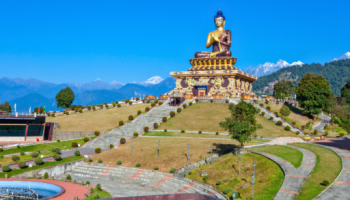
Tsomgo Lake and Nathula Pass: A Day Trip Guide from Gangtok
The trek from Gangtok to Tsomgo lake and Nathula Pass is a striking introduction to the high-altitude landscapes of East Sikkim that rise pretty fast from forested hills to the stark and barren rocky terrain of the Himalayas. The day trip which is a mix of natural beauty, cultural depth, and historical significance is mostly completed in a single day and hence, it feels very rich and you get to realize how geography, tradition, and strategic importance are interrelated in this region.
Also Read: Best Time to Visit Sikkim
Geographical Setting and Altitude Considerations
Tsomgo Lake is situated about 40 kilometers away from Gangtok at a height of around 3,780 meters. The lake is the result of melting glacial ice and is located in a crater of very steep mountain slopes that are snow-covered for most of the year. Its changes with the release of seasons can be seen easily— it is frozen and silent during winters, reflective in summers, and most of the time it is taken up by clouds during the monsoon.
Later on, if one keeps moving uphill, they will reach Nathula Pass which is approximately at 4,310 meters of altitude. The level here is quite a bit higher than before and thus, the consequences of the thin air can be felt very easily. Visitors might find it difficult to breathe, get tired, or even have headaches, especially if they go up very rapidly. It is better for the body to get used to the altitude change slowly if one spends at least a night in Gangtok before making the trip.
Tsomgo Lake is one of those places that is very dear to the hearts of the locals and has a lot of spiritual significance. It is the source of many traditional beliefs and in the past, the elderly used to interpret the changes in the lake’s color as the signs of the different seasons. Even now, the calmness that surrounds the lake is an indication of its cultural importance which is beyond its aesthetic value.
On the other hand, Nathula Pass is a very different but equally significant place. In the past, the pass was used as a major trading route between India and Tibet and many things such as wool, salt, and grains were exchanged between the two sides. As a result of the political issues between the two countries in the 20th century, the pass was closed to the public. At present, the Indian Army still keeps a close watch on it, and it is a place, which, apart from being a link between the past and the present, also symbolizes the realities of the border.
Neither Tsomgo Lake nor Nathula Pass would be accessible to you without an official permission because the area is situated near the border. Permits are given to travelers through the registered travel agencies located in Gangtok and it is done only after the application is sent. Visitors are asked to present their government-issued IDs along with passport-sized photos.
Weather also plays a major role in when one can get to Nathula Pass. Security forces inform about the condition of the road. They may shut off the path at any time without giving warning if there is a lot of snow or other adverse weather conditions. Taking up the services of experienced and knowledgeable local operators is a good way to make sure one is following all the rules and has the most current information about the trip.
Also Read: North Sikkim Travel Guide
The Journey from Gangtok
The big day for most of the planned excursions starts at dawn. To get from Gangtok to the must-see places of Tsomgo Lake or Nathula Pass, you need to follow the mountain road, which zigzags its way up the hills. Along the road, you get to see tall trees of the 4 & 5 types of the conifers, small rivers, and far-off mountain ridges. As you go higher, the trees will turn into bushes, and eventually, the landscape will be of a desolate, high-altitude kind.
Tsomgo Lake is normally the very first point of the long itinerary. There, people usually go for a walk near the lake, take photos, or just sit quietly and admire the peace of nature around them. At that time of the year, setting up local stalls is a great way for sellers to make money by providing hot drinks to the uninviting mountain air.
After that, the short trip which goes past the lake usually includes a stop at the Baba Harbhajan Singh memorial. This place, which is under the care of the Indian Army, tells the story of the HERO and is visited by the people who are traveling and looking for a quiet, reflective moment before continuing the ascent.
Experiencing Nathula Pass
The last part of the way to Nathula Pass is very steep and bare. There are also stronger winds and colder temperatures for sure. The time spent at the pass is always short due to the altitude and the air is thin. From the places where looking out is allowed, visitors will be able to see military installations and the vast views of the plateau around them.
There are rules for moving around and photography, and visitors are expected to abide by all the directions given by the security staff. The visit at Nathula Pass is less about having fun and more about grasping its location and strategic use.
Preparation and Practical Advice
Nothing like proper preparation is needed for this trip, which is at a very high altitude. Layered attire is something that the travelers should wear, and this should consist of insulated jackets, gloves, and something to cover the head. Along with this, a pair of shoes that is both comfortable and suitable for the rough terrain is equally important. If one is carrying water, light snacks, sunscreen, and lip balm, then he/she will be well equipped to face the harsh mountain conditions.
To avoid altitude sickness, visitors are advised to refrain from taking alcoholic beverages, eat light and nutritious meals and move slowly at high elevations. If you have any health conditions, it is better to see a doctor before making this trip.
A day trip from Gangtok to Tsomgo Lake and Nathula Pass is a powerful introduction to the high-altitude world of Sikkim. It is a combination of sacred nature, the historical trade routes, and the strategic mountain passes. As informative as it is visually striking, With diligent planning, respect for the local rules and awareness of the altitude challenges, this experience will be a great moment for traveling in the Eastern Himalayas.
Also Read: How to get Sikkim Permit Requirements
Book Now
with Your Trusted
Travel Partner
Travelangles.in!!
Discover Northeast India with ease – well-planned itineraries, trusted cabs, and comfortable stays, all managed by TravelAngles for a worry-free holiday
Your Journey,
Our Care !
From arrival to departure, TravelAngles ensures every detail of your trip is seamless — reliable drivers, handpicked stays, and experiences you’ll remember forever.

Related Tours
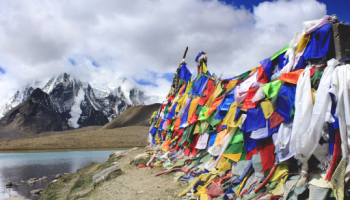
North Sikkim, Lachung, Gurudongmar Lake, and Yumthang Valley 6D/5N

Zuluk Sikkim 6D/5N